South Australian Aviation Museum
AIRCRAFT PROFILE
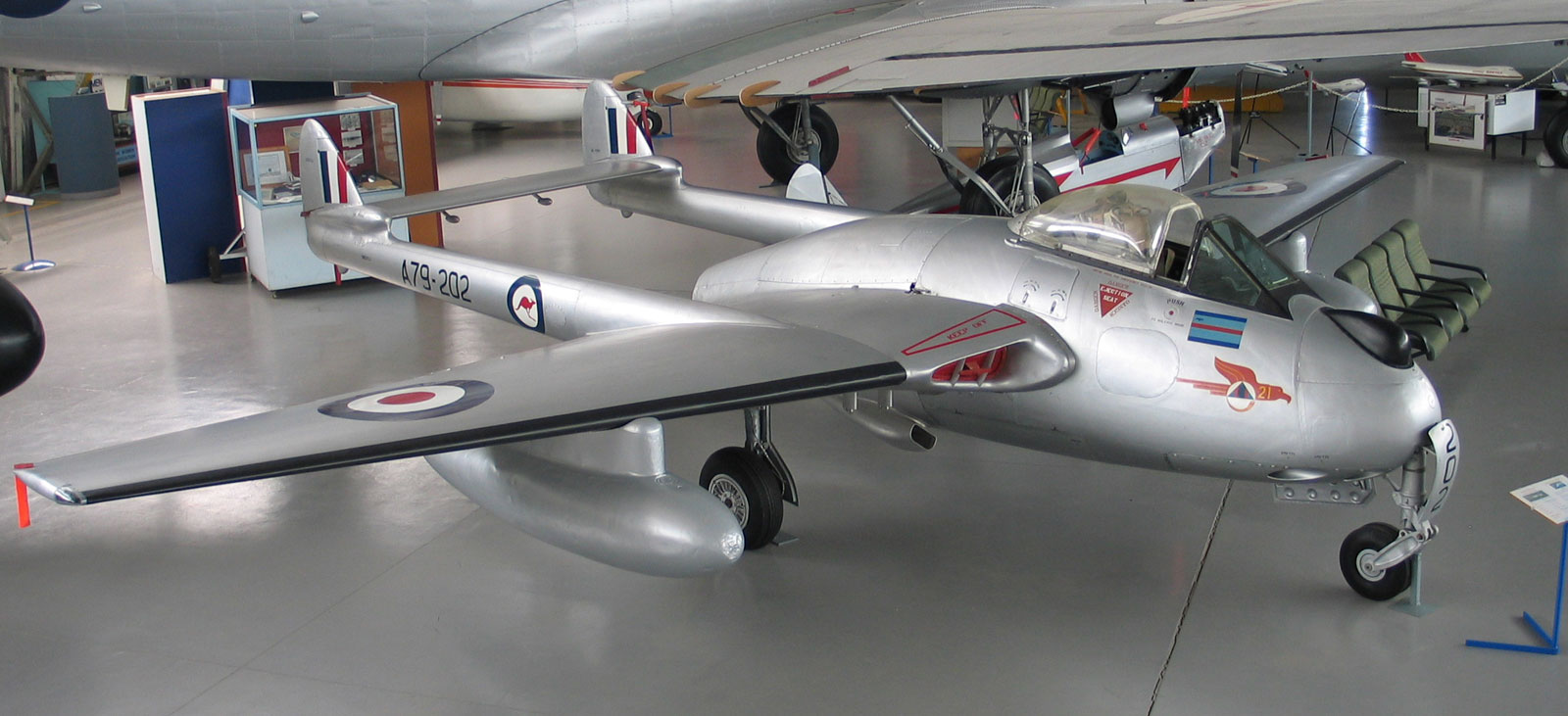
deHavilland DH-100 Vampire FB.31 A79-202
deHavilland DH-100 Vampire FB.31 A79-202
History of A79-202
Vampire A9-202 was delivered to the RAAF in November 1951 and allocated to RAAF Base Williamtown.
It was damaged in a wheels-up landing in 1953 and after repairs, served with Citizens Air Force No. 23 SQN from August 1955.
From July 1956 it served with No. 21 SQN. It served with ARDU Laverton in 1957.
History of Type
The prototype Vampire first flew from Hatfield, UK, on 29 September 1943, piloted by Geoffrey de Havilland Jr. It was a metal aircraft except for the plywood and balsa cockpit section. Vampires entered service with the RAF in June 1946 for use as a fighter and later as a trainer.
In 1946 approval was given for the purchase of an initial quantity of 50 Vampire aircraft for the RAAF. The first three machines were British-built aircraft, an F1, F2 and FB 5, and were given serial numbers A78-1 to 3. The second aircraft, the F 2 (A78-2), was significant in that it was powered by a Rolls Royce Nene jet engine, rather than the usual Goblin. All 80 F30 fighters and FB31 fighter-bomber aircraft built in Australia by the Commonwealth Aircraft Corporation were to be powered by CAC license-built versions of the Nene engine. In 1948, 80 Mk31 Vampires were delivered to the RAAF. All were built by de Havilland (Australia) at Bankstown, NSW, and fitted with the Rolls-Royce Nene engine. 100 two-seat trainers were also produced. The Vampire was the first jet-propelled fighter to enter service with the RAAF.
The first CAC-built Vampire F30 fighter (A79-1) flew for the first time in June 1949, and it was followed by 56 more F30 variants before the final 23 aircraft were completed as FB31s with strengthened and clipped wings with underwing hardpoints. The last FB31 was delivered in August 1953, and 24 late-production F 30s were subsequently upgraded to FB 31 standard. Of all the F 30 and FB 31 aircraft produced, only the first two had sequential serials, A79-1 and 2. For security reasons, all later serials were scrambled, the third aircraft being identified as A70-560 and the fourth was A79- 484 (for example).
Vampire trainer production amounted to 110 aircraft, and the initial order was filled by 35 T 33s for the RAAF, deliveries being made in 1952, and 5 T 35s for the Royal Australian Navy (RAN), delivered in 1954. One extra aircraft was later built to replace an RAN machine lost in an accident, this being produced to the later T 34A standard with ejection seats and improved canopy, and conforming to the same standard as the RAAF's later T 35A trainers (69 aircraft).
Serial numbers for the Vampire trainers were sequential. The T 33s and T 34s being serialed in the A79-800 range, while the T 35s were marked from A79-600.
Australia's Vampire operations were conducted under the auspices of No 78 Wing, comprising Nos 75 and 76 Squadrons. This Wing was sent to Malta in 1952 as part of the island's defences, and flew FB 9s hired from Britain and carrying RAF serials. The Wing took part in the 1953 Coronation Review and exercises in Germany before the deployment finished in 1954, marking the end of Vampire single-seat operations. Vampire fighters served with Nos 21, 22, 23, and 25 Squadrons of the Citizen's Air Force (CAF) until CAF flying ceased in 1954.
The trainer variants were operated by No 1 Advanced Flying Training School at RAAF Bases Point Cook and Pearce, the Central Flying School, and Nos 2 and 5 Operational Training Units. Trainers were also attached to the CAF squadrons. The Vampire trainers served until replaced by Macchi MB-326H aircraft from 1968, with the last sortie being flown in September 1970. RAN Vampire operations ceased the following year.
Technical Specifications
Engine: Rolls-Royce Nene turbojet of 5,000 lb thrust (22.3 kN)
Maximum take-off weight: 5,942 kg
Length: 9.4 m
Wing span: 11.6 m
Height: 2.7 m
Maximum speed: 475 kt (880 kph)
Range: 1,175 km (655 nm)
Crew: 1 pilot